Wednesday, 18 July 2012

#Wamathaijuly: Kenya's Poetry, Songs and Photography


On Saturday, the 14th of July 2012, I had the privilege of attending #Wamathaijuly at the Michael Joseph (MJ) Centre, Nairobi, Kenya. Well, you guessed it. It was an evening of poetry, song and photography. I enjoyed myself.


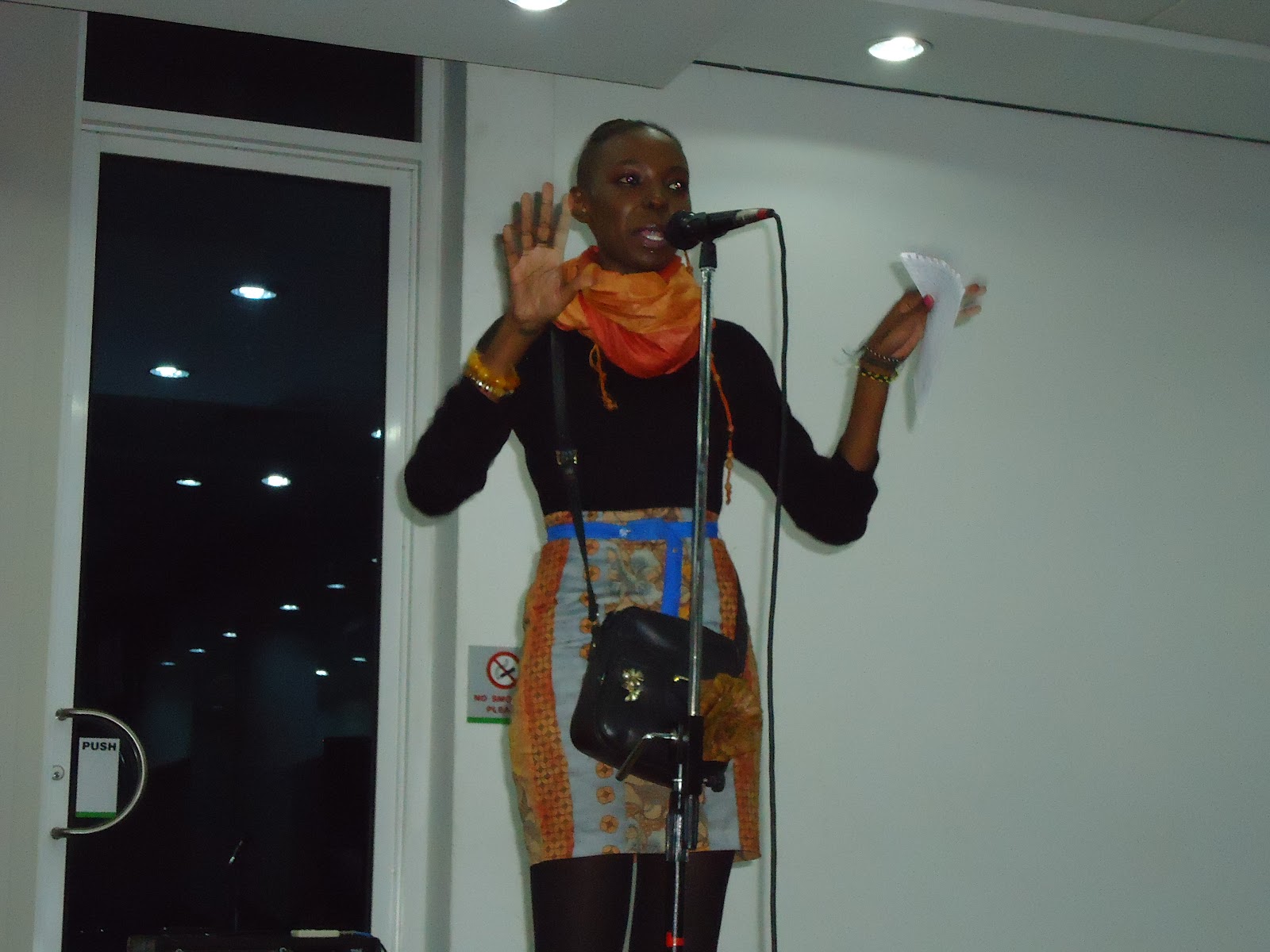
The emcees for the event were Sam Buggz and Stella Nasambu. In the photo is Stella Nasambu doing her stuff.


Elpoet performing and below with Samo & The Almighty, doing their favourite, "The School Bell Rings"


Jemedari performing his piece "Letter to the President" 


I was impressed by her. Didn't quite get her name but her Kiswahili poem was brilliant.


The drummer for DempseynTheBoys, the trio self-described as " A kenyan trio of ordinary guys performing extra-ordinary music". You have to check out DempseynTheBoys at twitter.


Below, Julie Wang'ombe perfoming her piece, "Genocide"


Wangari performing her piece "The Revolution will be Televised"


Njeri Wangari, favouritely known as Kenyanpoet on twitter, the author of the poetry book "Minds and Minefields" reading her poem and below, performing a moving piece lamenting the digital age.


Mwende Ngao (MwendeSusu, on twitter) performing her two pieces, 'Ground' and 'The Dream Valley'


Kavosa, performing her piece.


Wamathai, the host, the brainchild of #Wamathaijuly and wamathai performing two pieces.


Moraa Onsando, strumming the guitar, Kenya's diva to watch. Follow her music at www.soundcloud/moraa-onsando


KOA Photography. Check out what they have been up to here.


Bobby Muirugi, performing.


Ngartia, doing a vernacular piece. Great talent!


Si ni Sisi stole the show. Their costumes, their stage presence, the lead, the drummers, the dancers, everything about them was well choreographed and executed. Echoes of the Hills wishes you well.


"This was the life of the warriors!"


Adelle, performing her piece. Don't be sad, be happy, is all that we can say.


Ndila, performing "Mr. Jailer". Wonderful rendition!


Now looking forward to #WamathaiSeptember. 


Tuesday, 17 July 2012

Happy People


These people have discovered where happiness lies. I simply admire the elderly man in the merry-go-round, completely oblivious of what others might think about him.


Picture taken on 15th July at the Uhuru Park Recreational Grounds, Nairobi.


Monday, 9 July 2012

Let Kenya Be


We will never leave you
For at the darkest hours we stood by
We know your pain, for we have lived it,
We know what sorrow is, for we have felt it

Kenya, the land of hypocrites
Where, the sons of mau mau live in holes
Figuratively interred by the graves of their fathers
Yet you who have lived the pain, show us your scars
Show us your bullet marks, strip so that we may witness

We are the defining moment, countrymen and women,
The point where we are at take-off
We were left by Singapore and Korea
We cannot afford to get lost again

It has always been defining moments, for all we care
1963 was a defining moment too
And year by year, we have grown weary of speeches
Speeches coated with poetry and stolen from America
With time, brother, we have shut our ears to those take offs
1963, we had all the hope, all the dream, all the vision
What makes you think we are excited by these?

At independence, we swore to fight disease, ignorance and illiteracy
This remains our rallying call
And with it, we have new challenges,
Corruption at our offices, boss leadership,
Nepotism, favouritism, tunnel-visioned leadership…
Blah blah blah blah

Name them all, name them all,
But like a song from a scratched CD, you annoy,
There was a time we were excited by you,
You naming all the vices strangling us
And with the naiveté we had, we exclaimed,
‘Now, that is our prophet, our seer’
And with all our energy from our malnourished stomachs
We carried you high, your big body weighing upon us,
Some, like victims of any revolution, died from suffocation
Or dislocated spines, and we buried them silently
But now, you are no seer, tell us what you will do
When, how, why, and if need be slap your forehead
Lick your tongue and swear before our ancestors

This is the blue-print to our future, Wanjikus,
In it, I lay out what I will do for Kenya
In agriculture for example—no rain-fed agriculture
In security— two pistols for every cop
In education— a salary hike to teachers
In health— bigger and well-equipped hospitals

Blue-prints, that’s right,
Written by technocrats holed up in offices
Consulting on big tomes and countless reports
Pray, mr. blue-print, if only you listened to the
Hoes of farmers in the fields, you wouldn’t speak a thing
The police are shot every day, their numbers are few,
They live in decrepit shacks divided by curtains
And there you are, unashamedly promising them more pistols,
No, they need no pistols, they need more respect,
To patrol the city with the dignity worth their ranks
To retreat to houses that speaks of the Nation’s respect for them
The teachers, the teachers need not be lied to
As if they were the children they educate
We owe it to teachers for who we are,
Pray, was it fair to reduce all this to carrot and stick?
And health care, why should it be promised?
Why should doctors strike?
What message does it send to a mkokoteni pusher?

You have known me all this time,
I helped establish blah blah blah,
Trust me with this honour,
I am different
I am not like my predecessors
I was in a bad system
I was not corrupt

Same lies, same mouth, different times,
We have watched you silently, in disgust,
You talking in our TVs, speaking filth all your life,
You did less, you spoke much, you forgot us,
And in the corrupt system you grew up in,
You trained yourself how to bend your head,
To look away when the darkest crimes were committed
Your hands are filled with blood
Of the many you killed when you didn’t speak
You looted much, you gave less,
You have done a little less out of shame
Not by some sense of service within you
You are power-hungry, you are after yourself
And you are corrupt, very corrupt

What Kenya needs are leaders who can preach peace
We should not have a repeat of 2007/2008

Well said, well said,
Yes, they need leaders who can preach peace
Not you, not you,
You are the greatest enemy to Kenya’s peace
If only you had noticed how the skies sigh
Every time you spew bilge, you would not speak,
Why is it that vultures hover around your meetings?
May be I should not ask, but with respect,
You will do everyone good if you let Kenya be


Wednesday, 27 June 2012

Tororot Save Mombasa!


Yesterday, the 26th June, was the International Day against Drug Abuse and Illicit Trafficking. The day is an important one especially to Kenya. At the Coast of Kenya, drug abuse is a big issue. And from what has been reported in the media, illicit trafficking is also a big issue. It is so unfortunate that so many young persons have had their dreams go up, quite literally, in smoke. Mothers and wives are the hardest hit. Drunken husbands and wasted sons are every mother’s nightmare.


~

Link


his glazed, drunken eyes
barely open to the world shut before him;
his bony palms, arms jutting from the shoulders
like a marionette controlled by an amateur
the slow, sluggish mutterings of a disjointed being
held together by the buckle of an oversize belt and jeans
a torn t-shirt, worn out by cold weather and misery
teeth, like the face of a toothless character, stained
foul breathe stinking to the high heavens

you will find him in dark alleys
chanting incantations to the wall,
or as his body would direct
talking to stray malindi cats
at one time he was found sitting inside
a scrap car, humming an engine sound
shouting to the cops and cursing the other drivers
he also walks around with his abbot physics book
talking about ohms law and electrolysis
evidence of a fertile mind wasted

i just look at him, follow him around,
those eyes once had that spark
fixed on a shining star
his palms and arms once had vigour,
flowing with warmth and life
he once talked in rapid sentences
linking ideas into a philosophy
that was stringed in his want of change
he once was conscious of his being
or of what he wore or of his mouth
he once walked on the clean pavements
like the rest

but now, i look at him
he is living dead, shackled by cocaine,
his arm, injected  so many times, is dark
when he has his senses, he tells me,
“aisee, mihadarati si nzuri nakwambia,
niulize mimi, hata usijaribu, mimi miaka 9 nimeshindwa”
“friend, drugs are not good, just ask me,
never try them, i have tried leaving it for the last 9 years”

then he walks away, enters his “car”
and drives away
and something like a hot coal burns in my oesophagus
i feel like to scream, and under my breath,
i mutter: “Tororot save mombasa!”


Tuesday, 26 June 2012

the stars shine down upon you


we have come a long way
of that we are sure of;
a long, arduous journey
in search of life’s meaning
other’s found it in the faces of people;
others, as painters, expressed it
on canvas

but you, you Ziza,
found it in statutes
within these you labored
to understand justice and
rule of law and
court process

we celebrate you today
look, the stars shine down upon you
to speak of your will
unrelenting, indefatigable

so, Ziza,
march on, forge on
like the cyclops, the titans
arm yourself with virtues,
be unique like you are
the journey has started
the world is smiling back,
wakili

Yours truly, at the event


Notes:

Dedicated to a friend, Aziza Rajab, as a gift on her admission to the Bar. I felt like to edit it and embellish it a bit but I finally chose to reproduce it the same way I hurriedly wrote it beside the road. This poem was recited during the celebration on 23rd June 2012. I wish you well in your career. May it bring you fulfillment, calling upon you to serve humankind.

Whose Camel Sandals Are these?


Link

The feet of a pilgrim, steady as it might seem,
Can weave on sands, lost and directionless,
Made dusty by the desert storms

They too, like the broken compass,
Remind us all of what used to be;

In a desert, I saw an abandoned pair of camel sandals
While feeling it in my palms, I wept
Another pilgrim, lost and buried in the sand-dunes,
Must have met his death
The sandals spoke of his life
They were old and torn,
Evidence of how used they were,
On top of it, there were some beadworks
Strange it seemed, the desert offered such magnificence

May be he circled round and round,
Looking for an oasis
May be, just maybe-for the thought chokes me-
A violent storm buried him,
Or maybe he kept still somewhere at this spot,
Resigned to his fate, his life cast to the desert
Or maybe he just walked on and on
Conscious of the dissipating energy
Yet happy to be a traveler, nonetheless

I really wouldn’t tell
But these camel sandals
Is a labyrinth to his soul.


# In response to Poets United's Thursday Think Tank #102 Labyrinth.

Monday, 18 June 2012

My Peace I Give To You


Peace I leave with you; my peace I give you. I do not give to you as the world gives. Do not let your hearts be troubled and do not be afraid.

                            -John 14:27


 The poet is always indebted to the universe, paying interest and fines on sorrow

     -Vladimir Mayakovsky, Conversation with an Inspector of Taxes about Poetry

"Words are not our age-mates. Words can heal, but the same words can cripple a spirit. Words can motivate, but the same words can dampen the best of intentions. Words can be the harbingers of hope, but the same words can be of sorrow and much pain. Words kill. Words maim. Words can obliterate a nation. Words are not our age-mates. Always remember that."
~Yours Truly 


Today, I won’t write any poem. I will just speak to you. In Kenya, we mourn the loss of a Minister, an Assistant Minister, two pilots and two body guards. They died about a week ago through a fatal plane crash. My condolences to their families.

At the beginning of this year, I made a pledge that this blog will preach peace and brotherhood (sisterhood, you might also say) as Kenya gears up for her elections in March next year.

There was much violence and bloodletting in 2007/2008.

Ethnic tensions and animosity were stirred in people’s hearts. Brother descended upon brother, neighbor against neighbor. People were burnt. Arrows were aimed at fellow humans which left them dead or with brutal scars. Today, there are still people living in camps, with no place to go. Many are not healed. They carry scars in their hearts and the nightmare of 07/08 still disturbs them when they are awake and when they are asleep. Mothers buried their sons and nursed their raped daughters. They are forced to remain strong because even when they were raped and infected with HIV and AIDS, they have to hang on, else they will die. Their children, also living with them in camps, have grown to accept less in a society that has shunned them and relegated them to the periphery. They are the lesser mortals.

Blames have been leveled to many people — the government, the media, politicians, Kenyans themselves, e.t.c — but I haven’t heard it being laid on poets. The poets were guilty too. I use poets in a general sense to include bloggers or the citizen journalists.

They are to blame for remaining silent as the air smelt of human blood.

They are to blame for joining in the tirade, helping fan the ethnic diatribe.

They are to blame for using their words, not to inspire unity, but to sow discord.

They are to blame for absconding their roles as the fiduciaries of the society, them being blessed with wit and power of conviction.

I have written it here before that we are supposed to be the agents of peace. Words are not our age-mates. Words can heal, but the same words can cripple a spirit. Words can motivate, but the same words can dampen the best of intentions. Words can be the harbingers of hope, but the same words can be of sorrow and much pain. Words kill. Words maim. Words can obliterate a nation. Words are not our age-mates. Always remember that.

At this time, as we still mourn, let us remind ourselves that we are not immortal but frail and transient. We are leaves on branches which when blown by the wind of death, just fall off. The mouths which we use to spew bilge and filth will just rot. The mystery of death calls us to reflect on the duty we have of being agents of peace in Kenya and the world.

When I decided to open this blog, I realized the power it had right from the start. In the past, we had drums and smoke signals. Message transmission wasn’t that fast. Right now, this post is being read all over the world. Who ever knew that I would strike wonderful friendship from a wonderful soul in Canada? Who ever thought that I would have a friend in Nigeria or the United States?

Therefore, my daily challenge has been to exercise maximum restraint in what I write. It is never easy. In Kenya, I am afraid to say this, the temptation to appear “macho” is so real. Preaching peace is viewed as being “spineless” or being a “coward”. To fire salvos is viewed as being “brave” and “man enough”. To rally one-self into ethnic cocoons is viewed as not being a “betrayer” and being “our son”. Admonishing and throwing expletives at persons holding contrary opinions is viewed as being a “champion” and a “true fighter”. The ability to annoy so many in so short a span of time is a strength, not weakness. We get everything wrong but we, in a remarkable march to our assured failure, tread on. We are like the proverbial Abunuwasi in the Kiswahili fable who sits on the very branch that he cuts with a panga.

But I wouldn’t mind it much if our failures were personal. No, I wouldn’t mind it at all, anyway. But I mind it when we use the most potent tools at our disposal— the words— to tranquilize a whole society into non-action or to stir up their bloods to pointless confrontations and conflagration of emotions. This is unacceptable.

While eulogies were being given by our politicians, I was happy to note that most of them were calm and composed. They spoke softly and with measured restraint. Why can’t they speak like this for a month, just a month? After that, we will not worry much because after a month it will be their newly acquired habits.

As for us, the poets and versifiers, our duty is to make an impassioned plea for peace. We cry when another swats a butterfly on a wall. We stare at paints for hours, admiring their beauty and talent. We mourn when a minstrel loses a voice. Others look at cobwebs as dirt but we view them as inspiration for another poem. All our lives are spent examining this world with child-like curiosity, noting its peccadilloes, infractions, beauty, covered secrets, its silhouette of darkness. We don’t just look at a face. We want to see whether it is creased or buoyant, whether the eyes are burning with hope or sunken in hopelessness. We watch lapping waves keenly as scientists do on a specimen. We can pick a word, let it rest on our breasts, keep it away, draw it near again before finally placing it in the beak of a dove and let it fly to distant lands. We love the sea, we love the desert. We love the mountains, we love the plains. We are ticked by every minute detail in this world. If these be true, then, fellow pilgrim, then any disturbance to all these hurts us most. We are the greatest losers. Why then can’t we, even if it is for self-preservation’s sake, help nurture peace? 

Sunday, 17 June 2012

Father’s Day: Minstrel on this Earth


This poem honours my two dads, both deceased, one who sired me and the other who raised me. Both went to meet with the Lord. Wherever you are, I know you are watching over me.

W.H Auden's poem "Stop All the Clocks" befits the sorrow I felt. But I remain hopeful.

You could watch it here:


~

I have been avoiding mentioning this
For the past five years
So, I have always sung
But deep inside me I have been crying

My father,
I remember him telling me,
“My son, I have no wealth but faith,
We are all travellers on this earth”
He rode me in his bicycle and showed me
His tomato farm
And that day I messed up with his camera
Exposing the film, destroying all photos
He never descended on me in anger
May be he was very angry
Or it never showed

He now lies buried
A traveller he was, he said

Enigmatic, my dad was
Hardworking, my dad was
Religious, my dad was

August 2004
As I buried him, a part of me died too
“Stop all the clocks”, my heart cried
But my dad was no more
~
What happens when the one
Who you grew with tender and affection
Dies?
What happens when the very ground you stood on
Is pulled beneath your feet?
How do you react to the demise of one
Who bought you Oxford English Dictionary and Kamusi
And Read With Us and Hallo Children?

Usimlaumu dobi, kaniki rangile”, he always said,
Don’t blame the launder, a stained cloth remains so.
Achanikaye kwenye mpini hafi njaa”, he also told us,
Those who labour on their hoe’s handles don’t sleep hungry.
I remember the newspapers you always bought
And the academic cheer you always brought
You loved knowledge
I remember your challenge
“Which is a City within a City?”
We were clueless, you said “Vatican”

So, when I buried you
I held back tears, but for how long?
Thus, as mourners sang, I remembered
The good things you did, the wonderful times we shared
The thought that you were no more
Was so painful, so devastating
So I let my tears flow
Till now, a part of me lies buried with you

Salem, you named me,
When I read Hebrews 7: 1-,
PEACE is what my name means,
Lorot, you also named me,
Because I was born on the way,
No fancy hospital delivery

So, symbolically,
I am a minstrel on this earth
Singing peace to troubled souls
It is a sojourn, that much my birth shows,

Perhaps it was the loss of two people in my life
That drew me close to the love for all
I lost them, but found them in you all.


Bi Kidude


 While there’s life, there’s hope

     -Cicero, Letters to Atticus


When I first heard of Bi Kidude and later wrote an article about her, I had no idea that she was going to influence me in a profound way. Lately, I have been watching her songs particularly “Kijiti”, “Muhogo wa Jang’ombe”, “Alamidura” and even “Ahmada” which she sang with Off Side Trick (O,that name, mmmh). At more than 95 years of age, she still sings powerfully.Kijiti is one of the saddest songs I have ever watched and watching keenly Bi Kidude’s face as she sang it, I have never felt so moved by a song as she does.

Read an article I wrote about her: Bi Kidude, As Old as my Tongue.

You might also want to watch Bi Kidude's Taarab song, Kijiti, and let me hear what you have to say about it:


I also remember listening to "Muhogo wa Jang'ombe" when I was still a child and never knew that this wonderful woman was the one who had sang it. Graceful is the song. And don't you love the strength in this woman's voice?


~

Credit

Bi Kidude,
Niambie bibie, naomba kujua,
Msukumo watoa wapi?
Ni kipi kinakupa nguvu?

Bi Kidude
Tell me grandma, so that I may know,
What drives you?
What motivates you?

Kijiti.
Nikikutizama, wanataarab na vyombo
Nawe umesimama kidude
Kisha uimbe kuhusu kijiti
Kijiti.
When I look at you, fellow Taarab singers
You standing straight
Ready to belt out “Kijiti”

Bi Kidude,
Niambie bibie, naomba kujua,
Msukumo watoa wapi?
Ni kipi kinakupa nguvu?

O, Bi Kidude
Tell me grandma, so that I may know,
What drives you?
What motivates you?


You Might Also Like

Related Posts Plugin for WordPress, Blogger...

Disqus for Echoes of the Hills